Neptune Oud Bruin Ale
Part of my Planetary Series, eight Belgian Ales each inspired by a planet in our Solar System in increasingly tenuous ways…
Roughly 107 billion people have ever lived. Of those, 553 have technically left Earth and reached orbit. TWELVE people have stood on the moon. The probability of you or I ever visiting another planet in person is practically zero. But it’s fun to pour a nice strong Belgian beer and imagine it on a lazy Sunday afternoon.
Neptune is the furthest planet from our Sun. It takes about 164.8 years to make one complete orbit around the Sun (Earth, by definition, makes the trip in 1 year), which means it takes about 2.3 human generations for Neptune to complete just one Orbit. Likewise, this beer is only going to happen once in our lifetimes.
The reasons for this are complicated – in late 2017 a homebrew club I was a part of brewed a near 60 gallon batch of Oud Bruin. Each brewer produced between five to ten gallons and then we all combined our batches into a single 55 gallon oak barrel for extended aging. I brewed my share, it went into the barrel, and then I moved to China for two years. Not very long after returning to the USA for good in early 2020, a friend reminded me of the project and gave me my share – one five-gallon keg of nearly three year old Oud Bruin. I then forgot about it again, and left it in that same keg until late 2021 – when I rediscovered the keg and decided put it to work.
For the unfamiliar, Oud Bruin is probably up there with one of the oldest surviving beer styles – breweries in what is now Belgium were brewing this style when the Aztecs were at the height of their power. Brown in color, sour, slightly oaky – almost sherry-like – Oud Bruin is a style not many brewers today spend the time to make. It takes years for the flavors of Oud Bruin to properly develop, and because each batch is less controlled and more idiosyncratic, often brewers must blend multiple batches and/or vintages to achieve commercial consistency. There are certainly some American brewers making fantastic examples (New Belgium La Folie comes to mind), but in my opinion the best ones are still made in Belgium. Very difficult to find Brouwerij De Leite Cuvée Oncle Pol borders on a religious experience.
Oud Bruin is sour – and the dominant acid involved is acetic acid. I’ve never been a huge fan of acetic acid in beer, I much prefer lactic acid – the former being so harsh and the later being much softer. Either acid in beer is made usually by a bacteria – acetobacter in acetic acid’s case. While a yeast will covert sugars into alcohol and CO2 in weeks, acetobacter needs months or even years to do the slow work of producing acetic acid in the anoxic environment of fermented beer. The longer a brewer waits, the more acid will be produced.
Probably the most common commercial Oud Bruin (sometimes called Flanders Red – it’s a geography thing) you could find is Duchesse De Bourgogne, which I’ve always found to be way too acetic. It is a sour punch to the inside of your mouth and I cannot even drink a full glass of the stuff. It’s too much. Duchesse De Bourgogne shows up to Thanksgiving dinner wearing something designed exclusively to piss off grandma. Chill Duchesse – we get it, you’re different.
By now the 2017 batch isn’t quite De Bourgogne levels of acetic but it’s close, too close for my tastes. Further, the 2017 batch is really showing its age: the malt notes have almost all given way to oxidized sherryness – still interesting to be sure, but not nearly as drinkable as it should be. So to save this beer I decided to brew up a fresh batch in late 2021 of base beer: similar recipe as the 2017 batch but without the introduction of bacteria. A “clean”, non-sour version of the beer to blend against the very well aged and very sour 2017 batch.

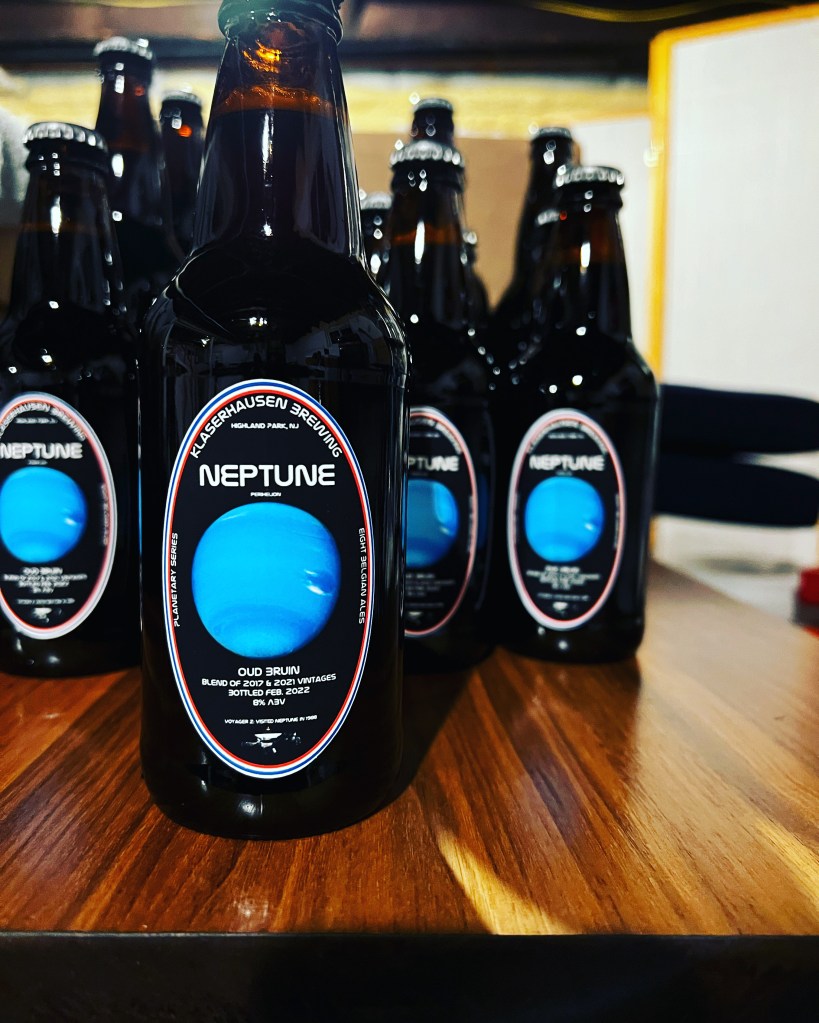
Once both were kegged, a close friend and I took on the terrible burden of tasting multiple ratios of the two beers in an attempt to find the perfect mix. We were very dutiful and dedicated, and many cheeses and cured meats were lost attempting to pair the blends to food, all in the selfless service of you dear reader. Despite our very rigorous studies we could not agree on a blend – so I decided to do two. One is a blend dominated by the older batch: Neptune Aphelion, while the other is dominated by the newer batch: Neptune Perihelion. Which is better? There’s only one way for you to know for sure.
Neptune Perihelion pours a ruddy brown with a tan head that quickly diminishes. Aromas are a mix of biscuit and prunes cut slowly as the beer warms with slight sherry-like character. On the palette, dark malts are in the lead – figs, plums, caramel, and treacle are complimented by acetic acid. On finish, there is a sweet and sour battle that ultimately finishes dry and very slightly sour.
Neptune Aphelion immediately shows its increased relative age in the glass: like an old red wine, the color is faded slightly and the beer is more clear if compared to Perihelion. The beer simply looks less lively – there is less head and very little lacing in the glass. The aromas are much more sherry forward and you can even smell the acid playing a more central role. There is a lot more oxidation at play here. The mouthfeel is thinner, and the sourness is much more pronounced – gone are the rich dark fruits and more simplistic, almost jolly rancher-like doppelgängers are in their place. The complexity isn’t in the malt anymore – it’s in the three way volley between jolly rancher, sherry, and acid. The finish is longer and much more sour – Aphelion begs for a nibble of cheese between sips.
I highly suggest you try these two beers side-by-side if you can. If eating bigger than cheese/charcuterie, I’d pair rich foods with plenty of protein, fat, and/or starch – cassoulet would be second to none with either blend. Serve in a glass with a flute that tapers inward, a white wine glass is perfect – if you send me a picture of this beer in a pint glass I will never speak to you again.
 Klaserhausen